Earnings look smooth—until one supplier sneezes
The quarterly chart can look almost too tidy: gross margin holds, backlog converts, guidance inches up. Then a small line item in the filings starts to nag—one upstream partner accounts for most of a critical input, and there isn’t a clear substitute that can scale on short notice. The market usually treats that as operational trivia right up until it stops being trivia. The uncomfortable part is timing: the stock can rerate long before any revenue miss shows up, because the risk is about continuity, not demand.
Supplier concentration often hides inside “consistent” results. If one vendor quietly sets lead times, allocates capacity, or controls a specialized component, earnings smoothness can be a fragile artifact of a single relationship. The constraint isn’t theoretical: one delayed shipment or quality slip can turn a clean quarter into expedited freight, idle labor, and a margin step-down that doesn’t reverse next month.
When single-sourcing looks like a competitive edge

In the good version of this story, the “one key supplier” note is there because the company earned it. Exclusive chemistry, proprietary tooling, a co-designed component, or a volume commitment can translate into higher yields and tighter specs, which then show up as cleaner warranty curves and a structurally better gross margin line. Management will frame it as focus: fewer variants to qualify, fewer quality systems to audit, lower working capital tied up in redundant inventory. That can be true, and it can even be a moat for a while.
The friction is that the same setup quietly shifts bargaining power. If the supplier holds unique capacity, the company’s cost of goods is no longer just a function of scale and learning; it’s a function of renewal dates, minimum-purchase clauses, and who eats inflation when contracts reset. The competitive edge can persist right up to the first renegotiation, when price steps, expedited freight, or tighter payment terms land in one quarter and don’t fully wash out. By then, the “efficiency” looks less like operating leverage and more like counterparty leverage.
The first mismatch: price resets change the model
The first real break in the spreadsheet usually isn’t a missed shipment; it’s a contract reset that quietly rewrites unit economics. A model built on stable input costs and operating leverage assumes the supplier is a pass-through line item. In practice, the supplier often has a calendar: annual index clauses, volume tier renegotiations, take-or-pay renewals, even a tooling “true-up” once yields settle. When that date arrives, the company can be forced to choose between protecting gross margin and protecting volume, and neither choice looks like the prior trend line.
What makes the reset dangerous is how it leaks through financials with a lag. Pricing to customers may be locked for a quarter or two, while the supplier’s increase hits immediately. Inventory can mask it—FIFO layers, pre-buying, or accounting for purchase price variances—until one quarter shows an abrupt margin step-down that doesn’t rebound. If the supplier also tightens payment terms, the hit is doubled: lower gross margin plus worse working capital, right when the market still expects “smooth” conversion.
The second mismatch: disruptions aren’t linear shocks
The next break rarely arrives as a neat “one-time” hit. A two-week slip in a constrained component can push final assembly past a customer ship window, which then pushes acceptance, which then pushes revenue recognition. Meanwhile fixed costs don’t pause, labor gets under-absorbed, and expedited freight shows up exactly when the supplier is rationing capacity. The spreadsheet treats disruption like a percentage haircut to volume; the business experiences it like a timing problem that turns into a margin problem, then a credibility problem, quarter by quarter.
Nonlinearity shows up in the ugly second-order terms: allocation rules that favor the supplier’s bigger customers, requalification lead times measured in months, and contractual penalties or “most-favored” clauses that limit how fast pricing can be repaired. Inventory buys time, but it also pulls cash forward at the worst moment, and the catch-up quarter often isn’t a snapback—mix shifts to lower-margin SKUs, backlog conversion weakens, and guidance gets narrower. After that, “resilience” stops being a narrative and becomes a calendar.
Reading the signals buried in public disclosures
By the time the calendar starts to matter, the cleanest signals are usually sitting in plain sight, just scattered. The first pass isn’t about the headline risk factor language; it’s about consistency across sections. If the 10-K says a single supplier is “sole source” for a critical input, then the inventory footnote, purchase commitments, and any customer concentration note should feel compatible. When they don’t—inventory rising while lead times are “stable,” or commitments stepping up while pricing is described as “competitive”—that’s often the earliest hint that continuity is being purchased, not earned.
Then it gets more specific and a little more tedious. Watch for quiet shifts: new mentions of expedited freight, “supplier quality” costs inside cost of revenue, unusual warranty accrual changes, or a working-capital drag that management attributes to “strategic inventory.” If the company starts talking about “dual sourcing initiatives” without timelines, or adds language about export controls, licensing, or country-of-origin constraints, that’s not noise—it’s the company admitting the substitute isn’t ready. The constraint is time: disclosures update slowly, but contract renewals and allocation decisions move on a quarter-to-quarter clock.
Stress-test outcomes, then resize the position
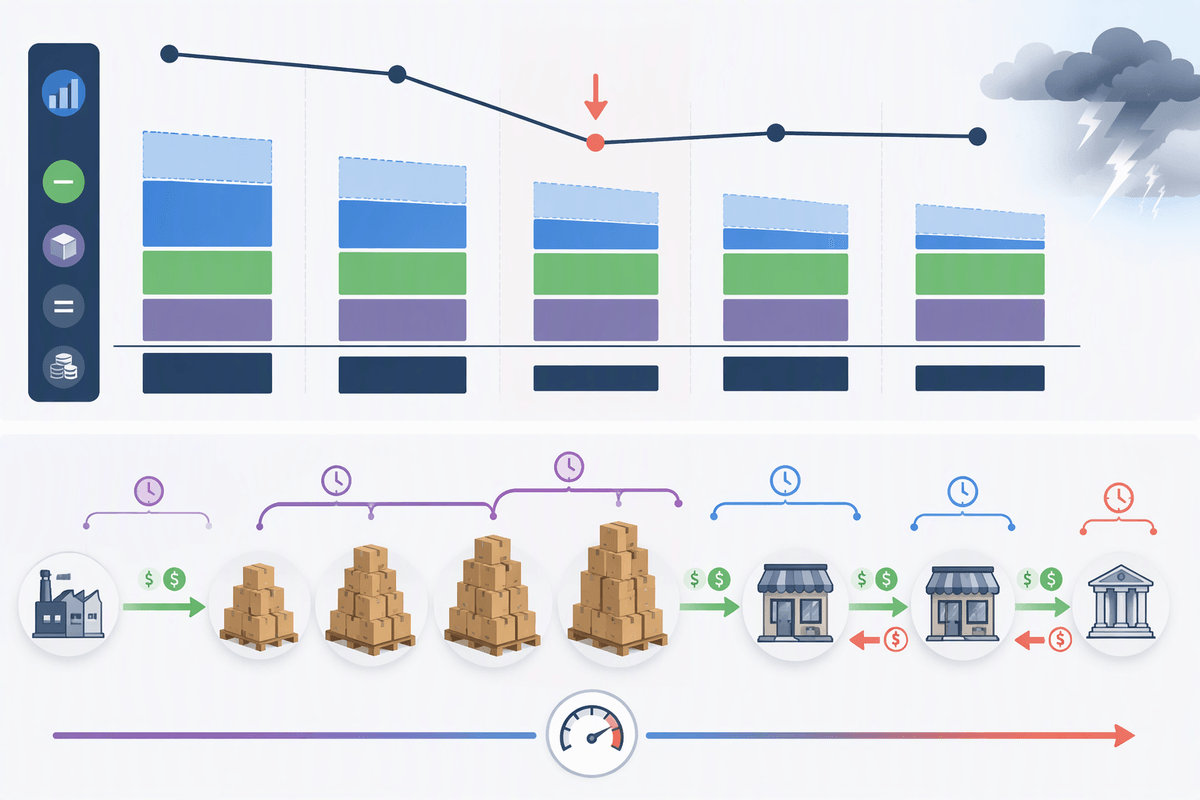
Once the disclosures start hinting that continuity is being “bought,” the next move is to stop arguing about narratives and run a few ugly cases through the income statement and cash cycle. A simple base case isn’t enough; build (1) a price-reset case with a 150–300 bps gross margin step-down for two to four quarters, (2) a disruption case where revenue slips one quarter but fixed costs stay put, and (3) a combined case where payment terms tighten and inventory days climb at the same time. The constraint is timing: even a short disruption can land in the quarter the market is least willing to underwrite.
Then resize the position as if the downside case is “possible,” not “remote.” If the stress case implies covenant pressure, a guide-down loop, or a multi-quarter multiple compression, it’s not a conviction-sized holding anymore. The goal shifts from being right on the thesis to surviving the calendar.
A disciplined stance: monitor triggers, not headlines
After the position is resized, the job becomes procedural. Set a short list of triggers that force an action: the next supplier contract renewal window, a predefined gross margin step-down, a threshold for inventory days plus payables days moving the wrong way, or repeated mentions of expedited freight and “strategic” builds. Pair that with a calendar—earnings dates, 10-Q/10-K filing windows, and any customer pricing reset cadence—so the risk is checked when the data actually updates.
Headlines will usually arrive late, and they rarely quantify duration. Triggers do: either the relationship is stabilizing inside the numbers, or the company is paying for continuity. That’s enough to hold, trim, or exit without pretending the next quarter will settle the story.